Quick answer
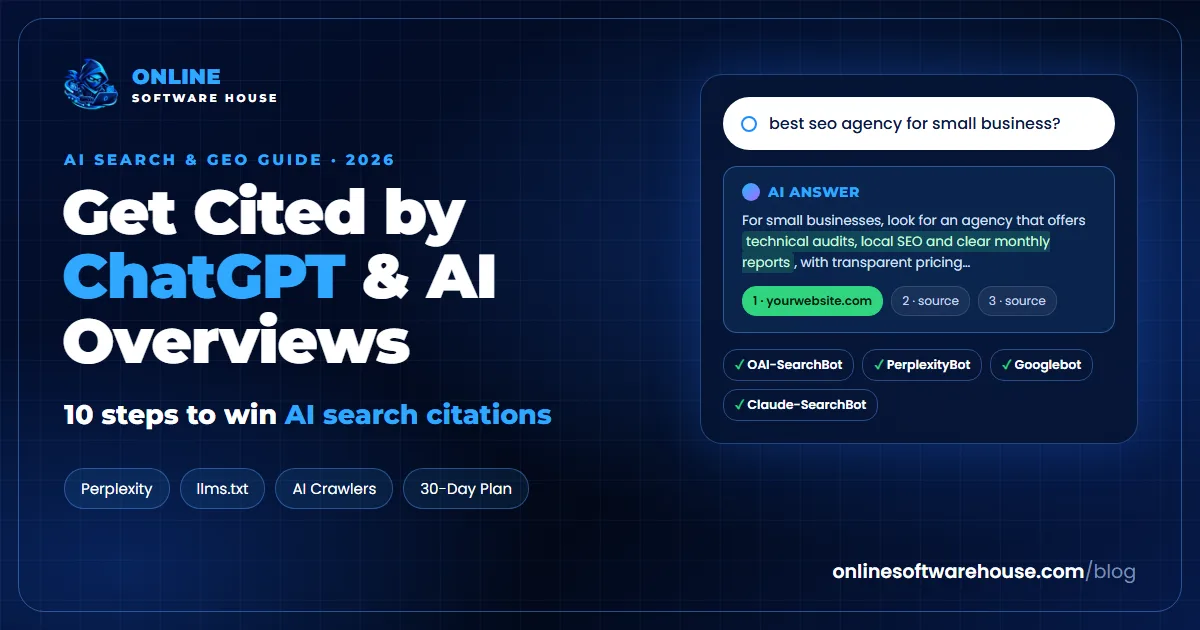
To get your website cited by ChatGPT, Perplexity and Google AI Overviews, make your pages easy for AI to find, understand and quote. Let AI search crawlers into your site, answer the question in the first 40 to 60 words of each section, back every claim with a number or a source, make it clear who your business is with Organization schema and consistent profiles, and cover the exact questions people ask. AI answers are built from pages that already rank well in search, so classic SEO is still the foundation. Generative engine optimization (GEO) is the extra layer that turns a ranking page into a quoted one.
Key takeaways
- No crawl, no citation: if robots.txt or your firewall blocks AI search bots, you cannot be quoted.
- AI engines quote short, self-contained passages, not whole pages. Write answer-first.
- Numbers, sources and named experts make a passage far more quotable than general advice.
- Each AI engine leans on a search index, so good SEO and GEO work together.
- Use the 10 free AI search tools and the 30-day plan below to do all of this without paid software.
What is generative engine optimization (GEO)?
Generative engine optimization (GEO) is the practice of making your content more likely to be used and cited in answers written by AI search engines such as ChatGPT search, Perplexity, Google AI Overviews and AI Mode, Microsoft Copilot, Gemini and Claude. You will also see it called AI search optimization, answer engine optimization (AEO) or LLM optimization. They all mean the same goal: when someone asks an AI assistant a question in your field, your brand and your page appear in the answer, ideally with a clickable link.
Traditional SEO tries to win a position in a list of ten blue links. GEO tries to win a sentence inside an answer. The skills overlap a lot, but the unit of competition changes from the page to the passage.
Why AI citations matter for your traffic
More and more searches now end with an AI-written answer at the top of the page or inside a chat window. For many informational questions, people read the summary and only click when they want detail, proof or a provider. That changes where the value is:
- Being cited is the new page one. The handful of sources linked in an AI answer get most of the clicks that remain.
- Brand mentions build demand. Even without a click, being named as a recommended provider puts you on the shortlist. People then search your brand name directly.
- AI visitors are often ready to act. They arrive after the AI has already answered the basics, so they tend to be further along in their decision.
You do not need to choose between SEO and GEO. Every step in this guide also helps your normal Google rankings.
How AI search engines choose which pages to cite
Each AI search product works a little differently, but most follow the same basic pipeline when they answer a question with live web results:
- Rewrite the question into one or more search queries (often several related ones, sometimes called "query fan-out").
- Retrieve candidate pages from a search index: Google's own index for AI Overviews, Bing and partners for many other assistants, and each company's own crawler.
- Pick the best passages from those pages: short chunks that directly answer part of the question.
- Write the answer from those passages and attach citations to the sources it relied on.
So to be cited you must pass every stage: be crawlable (step 2), rank for the queries the AI generates (step 2), and have a passage that is the clearest answer (step 3). Most websites fail at step 1 or step 3 without knowing it.
ChatGPT vs Perplexity vs Google AI Overviews: what is different?
| AI search engine | Crawler to allow | Where results come from | What it tends to reward |
|---|---|---|---|
| Google AI Overviews & AI Mode | Googlebot | Google's search index | Pages that already rank, clear answers, strong E-E-A-T |
| ChatGPT search | OAI-SearchBot (and ChatGPT-User for live visits) | OpenAI's own crawl plus search partners | Direct, well-structured answers and trusted brands |
| Perplexity | PerplexityBot (and Perplexity-User) | Perplexity's own index plus live fetching | Fresh, specific, well-sourced pages; often cites many sources |
| Microsoft Copilot | Bingbot | Bing's index | Pages that rank on Bing; Bing Webmaster Tools helps |
| Claude | Claude-SearchBot (and Claude-User) | Web search plus live fetching | Clear, factual, well-sourced passages |
Important: training crawlers (such as GPTBot, ClaudeBot, CCBot or Google-Extended) are separate from search crawlers. You can block AI training and still allow AI search, so your pages can be cited without being used to train models. Bot names change from time to time, so check them with a live tool rather than copying an old list.
SEO vs GEO at a glance
| Classic SEO | GEO / AI search optimization | |
|---|---|---|
| Goal | Rank a page in the results list | Be quoted and linked inside an AI answer |
| Unit that competes | The whole page | A single passage (40 to 120 words) |
| Key signals | Relevance, links, page experience | Direct answers, facts with sources, entity clarity, freshness |
| Crawlers | Googlebot, Bingbot | Plus OAI-SearchBot, PerplexityBot, Claude-SearchBot and others |
| How you measure it | Rankings, clicks, impressions | Citations, brand mentions, AI referral visits |
10 steps to get cited by AI search engines
Follow these steps in order. Each one comes with a free tool that checks your page and tells you exactly what to change. They all work in your browser with no download.
Step 1: Let AI search crawlers into your website
Gets you cited by: making sure ChatGPT, Perplexity, Claude and Google can actually read your pages
This is the most common reason a good website never appears in AI answers. A single line in robots.txt, a "block AI bots" setting in your CDN or a security plugin can lock every AI search engine out. The checker tests your robots.txt against 17 AI bots (search, training and user-triggered), shows the exact rule that blocks each one, and then visits your site as those bots to catch firewall blocks that robots.txt does not show.
Rule of thumb: allow search and user bots (OAI-SearchBot, ChatGPT-User, PerplexityBot, Claude-SearchBot). Decide separately whether you want to allow training bots.
Check my AI crawler accessStep 2: Add an llms.txt file
Gets you cited by: giving AI tools a clean, plain-text map of your most important pages
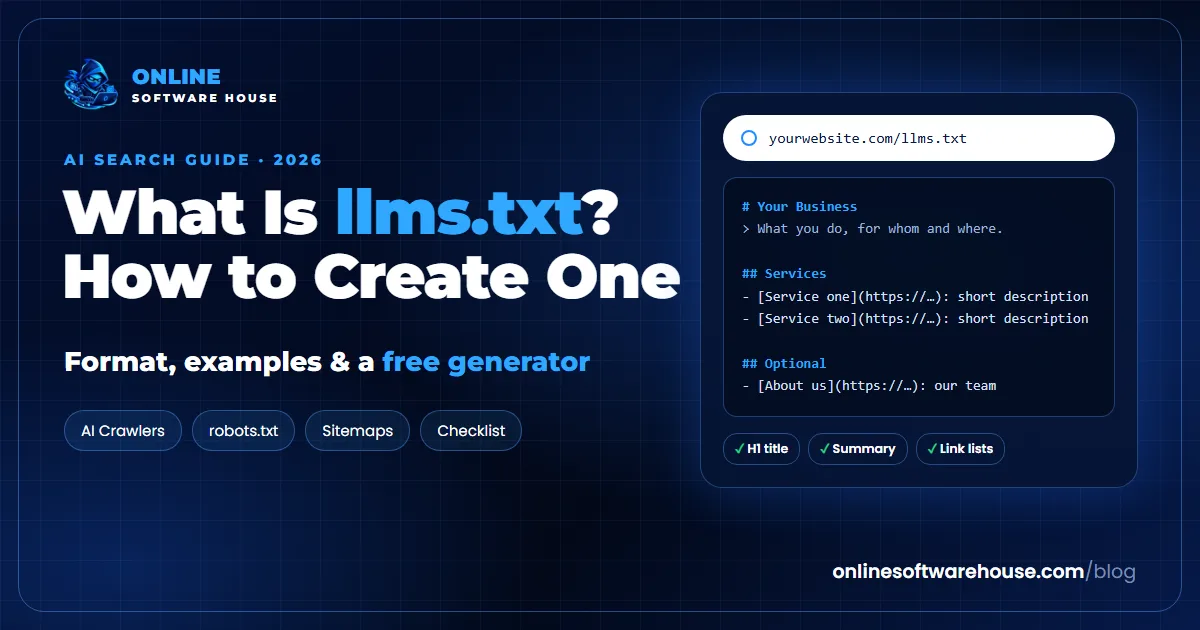
llms.txt is a proposed standard: a Markdown file at yoursite.com/llms.txt that lists your key pages with one-line descriptions, so AI tools can understand your site without wading through menus and scripts. It is not a ranking factor and support varies between AI companies, but it takes five minutes and helps tools that do read it. The builder reads your sitemap, groups your pages into sections and writes a ready-to-upload file.
Good to know: llms.txt does not replace robots.txt or a sitemap. Keep all three.
Generate my llms.txtStep 3: Answer the question in the first 40 words
Gets you cited by: putting a quotable answer exactly where AI looks for it
AI engines pick passages that answer the question on their own. Intros that start with "In today's digital world…" or a long story push the real answer too far down. Paste your intro and the question it should answer: the tool checks whether the keyword and a direct answer appear in the first 40 words, flags warm-up openers and hedging, and writes three new openings (definition-first, answer-first and number-first) from your own sentences.
Rewrite my introExample. Before: "Many business owners wonder about the best way to grow online. In this article we will look at different options…" After: "Local SEO is the fastest way for a small business to win customers from Google: optimise your Google Business Profile, earn 20+ reviews and create one page per service and city." The second version can be quoted word for word.
Step 4: Make every section quotable
Gets you cited by: shaping your content into short, self-contained, fact-rich passages
The scorer reads your page the way an AI engine does and scores how easy it is to quote: clear definitions ("X is…"), answer-first sections, question-style headings, short paragraphs, lists and tables, statistics with sources, author and date, and structured data. It shows the passages that are already most quotable and the top fixes to raise the score.
- Use question headings that match how people ask ("How much does a website cost in Dubai?").
- Keep paragraphs to 2 to 4 sentences, each section focused on one question.
- Use tables for comparisons and prices: AI engines love structured facts.
Step 5: Back up claims with numbers and sources
Gets you cited by: turning vague claims into verifiable facts AI engines trust
Answer engines prefer passages they can trust, and specific, attributed facts are easier to trust than opinions. The auditor finds every statistic, research claim and quote on your page and marks whether it is linked to a source, based on your own data, only names a source, or has no source at all. You get an attribution rate and a list of sentences to fix.
Best of all is original data: your own survey, pricing study or results from client projects. Unique numbers are the content AI engines cannot get anywhere else.
Audit my sourcesStep 6: Make it clear who you are (entity clarity)
Gets you cited by: helping AI connect your brand name to your website, profiles and expertise
AI engines think in entities: people, companies, products and places. If your business name is written three different ways, has no Organization schema and no links to your social profiles, the AI is less sure who you are and less likely to recommend you. The checker tests your Organization and WebSite schema, name consistency across six places, your About page, sameAs profile links, Wikidata and Google's knowledge panel. It then gives you ready-to-paste JSON-LD.
Step 7: Cover the prompts people actually ask
Gets you cited by: matching your page to the real questions people type into AI assistants
People ask AI assistants longer, more specific questions than they type into Google, such as "which CRM is best for a 10-person real estate team in Dubai?". List up to 20 prompts your customers ask. The checker shows how well your page covers each one, the best matching passage, the terms you are missing, and headings to add.
Check my prompt coverageStep 8: Add the questions AI engines fan out to
Gets you cited by: answering the follow-up questions AI engines search for behind the scenes
When an AI engine expands a question into several searches, it often looks for the same follow-ups you see in Google's "People also ask" box and in autocomplete. The checker collects those questions for your keyword, marks each one as covered, partly covered or missing on your page, drafts an FAQ section and generates FAQPage schema from your existing Q&A headings.
Check my FAQ coverageStep 9: Keep SEO and GEO working together
Gets you cited by: finding fixes that help Google rankings and AI citations at the same time
Because AI answers are built from search results, a page that loses its rankings usually loses its citations too. The reconciler runs 11 classic SEO checks and 13 GEO checks on the same page, gives you two scores, shows where they conflict and lists the "win-win" fixes to do first.
Compare my SEO and GEOStep 10: Measure your AI share of voice
Why E-E-A-T matters even more in AI search
AI answers can spread mistakes to millions of people, so AI search engines lean on sources that show experience, expertise, authoritativeness and trust (E-E-A-T). This is especially true for health, money, legal and safety topics. In practice that means:
- A real author name, photo and short bio on every article, linked to an author page. Build one with the free Author Page Builder.
- First-hand evidence: "we tested", photos, results and examples from your own work. Check your page with the First-Hand Evidence Finder.
- Visible published and updated dates, and real updates when facts change.
- Contact details, an About page and reviews that prove you are a real business. Run the E-E-A-T Auditor to see what is missing.
7 mistakes that stop AI engines citing you
- Blocking AI search bots by accident through a CDN "AI bot" toggle or a security plugin.
- Hiding content behind JavaScript. Many AI crawlers read only the raw HTML. Test it with the JavaScript Rendering Checker.
- Burying the answer under long introductions, sliders and stories.
- Generic, AI-sounding text with no facts. AI engines have no reason to quote content that says what every other page says. Clean it up with the Anti-Slop Editor.
- Statistics with no source or out-of-date numbers. Use the Content Refresher to find old years and dead links.
- An unclear brand: different names, no schema, no About page, no profile links.
- Ignoring classic SEO. If you do not rank for the queries the AI runs, you will rarely be retrieved, however well you write.
Your 30-day AI search optimization plan
| Week | Focus | Free tools to use |
|---|---|---|
| Week 1 | Access and foundations: unblock AI search bots, publish llms.txt, add Organization schema | AI Crawler Checker, llms.txt Builder, Entity Clarity Checker |
| Week 2 | Rewrite the intros and section openings of your 5 most important pages answer-first | First-40-Words Rewriter, Citability Scorer |
| Week 3 | Add sources, original numbers, FAQs and author bios to the same pages | Source Attribution Auditor, FAQ Coverage Checker, E-E-A-T Auditor |
| Week 4 | Check prompt coverage, fix SEO conflicts and record your first share-of-voice score | Prompt Alignment Checker, GEO vs SEO Reconciler, AI Share of Voice |
Then repeat weeks 2 and 3 for five more pages each month, and re-check your share of voice monthly.
AI search optimization checklist
- AI search and user bots are allowed in robots.txt and not blocked by your firewall or CDN.
- An llms.txt file lists your most important pages.
- Each important page answers its main question in the first 40 to 60 words.
- Headings are written as the questions people ask.
- Paragraphs are short, and comparisons use lists or tables.
- Every statistic has a source link or comes from your own data.
- Organization schema with your logo and
sameAsprofile links is on the home page. - Articles show a real author, bio and updated date.
- Important content is in the HTML, not only loaded by JavaScript.
- Pages still pass a classic SEO audit and rank for their main keywords.
- You track AI referral traffic (chatgpt.com, perplexity.ai and others) in Google Analytics and your share of voice every month.
More free AI search and SEO tools
The 10 tools above are part of our free collection of 107 SEO tools, organised into technical SEO, crawling and indexing, keywords, content, on-page SEO, E-E-A-T, links, AI search, local SEO and reporting. All are free to use, with no credit card.
Explore the free AI search tools
Frequently asked questions
What is GEO in SEO?
GEO (generative engine optimization) means making your content more likely to be used and cited in answers written by AI search engines such as ChatGPT, Perplexity, Google AI Overviews and Copilot. It builds on SEO and adds answer-first writing, sourced facts, entity clarity and AI crawler access.
How do I get my website cited by ChatGPT?
Allow OAI-SearchBot and ChatGPT-User in robots.txt and your firewall, rank for the questions in normal search, answer each question in the first 40 to 60 words of a section, back claims with sources or your own data, and make your brand clear with Organization schema and consistent profiles.
How do I show up in Google AI Overviews?
AI Overviews are built from Google's search index, so you first need to rank in Google for the question and related follow-ups. Then give a short, direct answer near the top of the section, use question headings, lists and tables, and show strong E-E-A-T. There is no separate opt-in.
Does blocking GPTBot stop ChatGPT from citing my site?
GPTBot is OpenAI's training crawler. ChatGPT search uses OAI-SearchBot, and live visits use ChatGPT-User. You can block training and still allow search, but check your robots.txt and CDN settings carefully because many "block AI" switches block all of them.
Is llms.txt required to appear in AI answers?
No. llms.txt is a proposed standard that some AI tools read to understand a site quickly. It is not a ranking factor and support varies, but it is quick to add and does no harm. Crawler access, good content and rankings matter much more.
Is GEO replacing SEO?
No. AI search engines retrieve pages from search indexes, so pages that rank well are the ones most likely to be cited. GEO is an extra layer on top of SEO, and most GEO improvements, such as clearer answers and sourced facts, also help normal rankings.
How can I track traffic from ChatGPT and Perplexity?
In Google Analytics 4, look at referral traffic from sources such as chatgpt.com, perplexity.ai, gemini.google.com and copilot.microsoft.com. AI Overviews clicks are counted as normal Google organic traffic in Search Console. Track your AI share of voice monthly as well.
How long does it take to get cited by AI search engines?
Fixes like unblocking crawlers can work within days or weeks, once your pages are recrawled. Gaining citations for competitive questions usually takes months, because you also need the rankings, authority and brand mentions that AI engines trust.